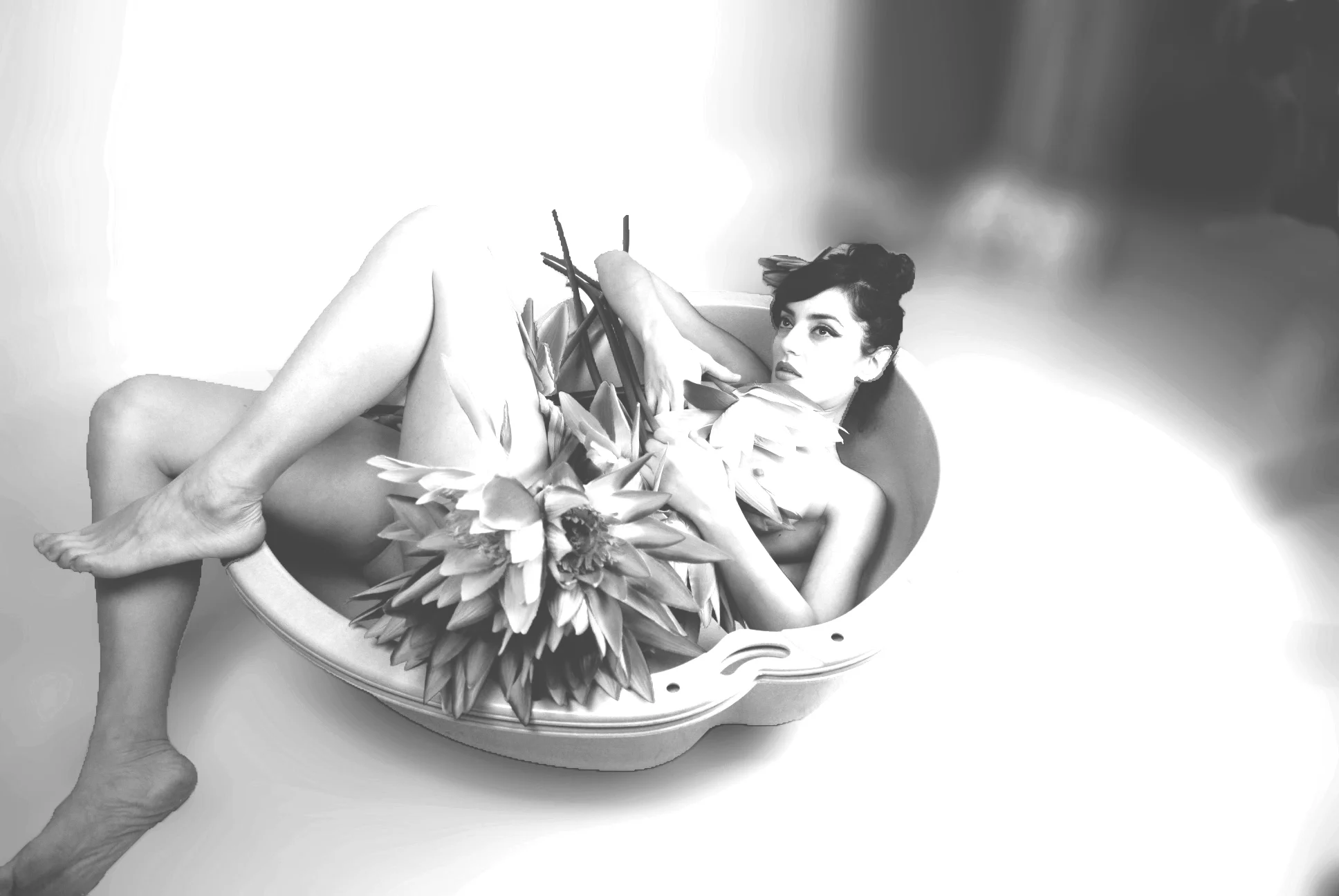
Born in Athens, Elena Poka moves between image and stage, myth and contemporary reality, with a practice that is both rigorous and visionary. She graduated with honours from the Athens School of Fine Arts in 2005 and completed her Master’s degree in Contemporary Theatre at Brunel University in 2007, cultivating from early on a dialogue between visual language and performative action.
As a visual artist, her work has been presented in international exhibitions and is held in private collections and museums. Her practice resists confinement within a single medium; instead, it unfolds across forms, seeking the point where visual art becomes embodied experience and theatre becomes a living image.
From 2011 to 2018, she founded and directed the Elena Poka Company, through which she conceived and produced a series of original theatrical works. Among its most significant productions was The Return of Persephone, which premiered at the Stoff Theatre Festival in Stockholm in 2013. In the years that followed, the work evolved into a site-specific theatrical piece, created for and within the historic centre of London. First presented there in December 2016 and performed again in April 2017, the production transformed urban space into a contemporary mythic landscape.
Since 2018, Elena Poka has been based in Athens, where she maintains a studio dedicated equally to fine art and theatre. This space functions as both workshop and laboratory—a site of research into image, body, memory, and transformation.
At the heart of her work lies a sustained engagement with myth—not as fixed narrative, but as living structure open to reinvention. She is drawn to the fluidity of human nature: its capacity to move between the animal and the over-human, between instinct and transcendence, and through the shifting territories that lie in between. Her practice frequently approaches the threshold between life and death, tracing the fragile line where opposites converge and identities dissolve.
Through these explorations, her intention is to interrupt the habitual rhythms of daily life. Whether addressing a prepared audience or unsuspecting passersby, she creates moments of suspension—intervals in which spectators are invited to reconsider their position within the margins she reveals. In these liminal spaces, myth re-emerges as a contemporary force, and art becomes an act of awakening.